FWA Annual Summit Recap: Disrupting Wall Street

October 24, 2025

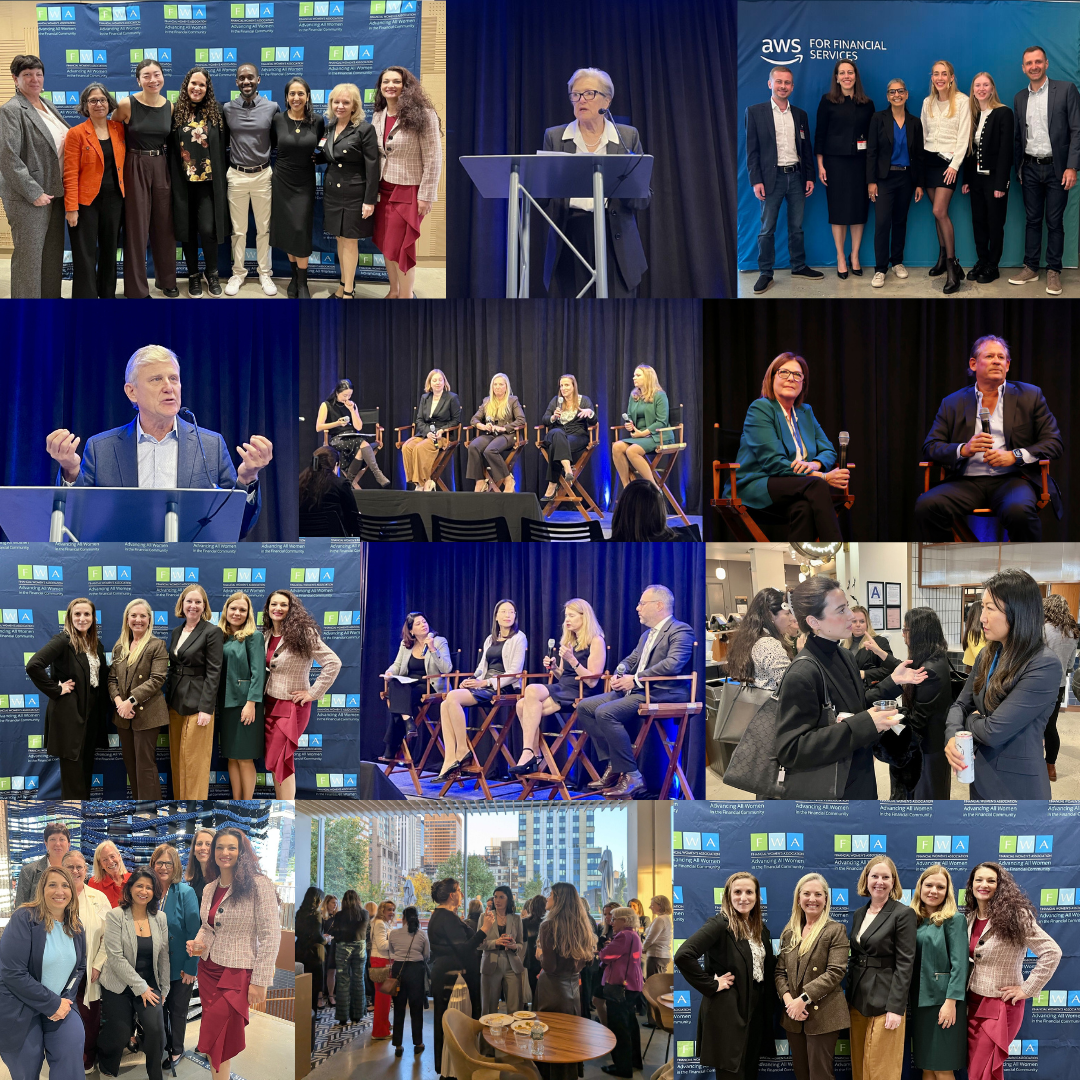
On Tuesday, October 21, 2025, the Financial Women's Association's Annual Summit: Disrupting Wall Street highlighted how disruption is touching every aspect of our industry - from our cities and workplaces to the global economy. From Kathryn Wylde's call to rebuild public-private partnerships to Rick Rieder's global outlook, we were reminded that we're living through a new kind of industrial revolution. Every session pushed us to think bigger.


We began with a powerful keynote from Kathryn Wylde who reminded us of the urgent need to revive public–private partnerships, particularly amid uncertainty in our own city. Conversations in following panels turned to the adoption of AI within individual firms, and considered how it is changing how we work on a day-to-day basis, fundamental aspects of our organizational structures and how they operate, and wider macro implications of advances in technology which will foundationally impact employment and education. 


Many speakers addressed the fact that we will need to learn to manage the masses of data at our disposal and the various implications of its usage. We are seeing the rise of the sophisticated retail investor in the markets, and increased discussions about the role of private credit markets.


Here in NYC, we are known as the hub for Fintech and second only to Silicon Valley in venture capital. There is a revolution going on here too from increased investment in helping people to build financial resiliency or the disruption of the ecosystem to bring more capital to female or mixed gender led businesses. The enormity of the upcoming wealth transfer to women will only exacerbate this change.


Yet amid all the talk of advances in technology and continued innovation, one key message came through clearly: the human component remains front and center. Leaders shared the value they place in collaboration and networking, and numerous speakers emphasized the concept of trust, whether it is between private and public partnerships, the ability of leaders to support their employees as AI is adopted within their firms, the relationships with regulators, or the acceleration of Fintech.


Culture and behavior are also key; many of our speakers talked about experimentation, democratization, and staying curious. They reminded us not to be afraid of change and to seek out others to learn from. While some of these things may at times feel daunting, it can also be a time of exhilaration. We at the FWA are excited to be a part of your journey through all of this - supporting our members as they navigate and shape the future of finance.


Thank you to our incredible host, Amazon Web Services (AWS), our Summit Sponsors Korn Ferry, Trianz, Concierto, and N-iX, our Promotional Partners Al NYC, TechWalk NYC, and This Week in Fintech, and our event organizers, the FWA Annual Summit and Fintech Committees. To every speaker, attendee, and committee member who helped make the day unforgettable, thank you for showing up ready to learn, share, and make an impact.
April 23, 2026
For months, FWA Executive Director Alissa Desmarais and I had been building toward something incredible: a six-day International Business Conference in the UAE, complex and high-stakes, the kind of undertaking that requires you to hold a hundred things in your head at once while also holding your team together, your partners together, and yourself together. The FWA has more than 40 years of experience organizing international conferences around the world; what we were doing was not new. But as we stepped into our new roles as the conference organizers, with the support of a great IBC committee, this one felt different. More meaningful, because it was ours. We were proud of what we were creating. And then the world changed around us. I won’t pretend the decision to pivot was easy, because it wasn’t. There is a particular kind of grief that comes not from losing something you already had, but from letting go of something you had worked so hard to build and had not yet gotten to experience. We had to look at the geopolitical reality of the region, at what was happening, at what we could not control, and make a call. The kind of call that no planning document prepares you for. We chose to pivot. On May 5th and 6th, FWA will host the Global Capital and Leadership Forum in New York. A virtual lunch panel, followed by an in-person morning program at Akin, right in the heart of the city. Smaller in scale, yes. But not smaller in purpose. We kept the questions we had always meant to explore: how shifting alliances and energy transitions are redrawing the map of global capital, what resilient leadership looks like in a world that will not hold still, how women are shaping the future of finance across cultures and geographies. Her Excellency Amna Almheiri, Consul General of the United Arab Emirates in New York, will close our forum. The relationship did not end when our plans changed. The dialogue did not stop. It just found a different room. What I have learned from this experience is something I keep coming back to: a pivot is not the opposite of commitment. Done with clarity and care, it is one of commitment’s truest expressions, because it means you care more about the mission than about being right about how you planned to serve it. It means you can look at the people who gave months of real effort to a plan that changed and help them see that nothing they did was wasted, because it wasn’t. It means you can let go of the version of success you had pictured and trust that a different shape can carry the same substance. I think about the women in this community who have had to do this in their own careers and lives. Who had to walk away from something they had built toward for years, not because they failed but because the world shifted and they were honest enough to shift with it. That takes courage. It takes the kind of steadiness that is very easy to admire from the outside and very hard to practice from the inside. The forum is still taking shape. The work continues. And I am proud of what we are making, not in spite of how we got here, but because of it.
April 9, 2026
The MENA Capital Landscape: Risk, Resilience & the Road Ahead May 5–6, 2026 Join the Financial Women's Association for a timely conversation on sovereign capital, energy transition, AI, and the geopolitical forces reshaping global finance. When our UAE trip was cancelled, we immediately looked for ways to bring the experience to our community here in NYC - this forum captures the spirit, substance, and strategic importance of that journey. Registration details coming soon - save the date on your calendar now! Virtual Lunch Panel · Tuesday, May 5 In-Person Morning Program in New York City · Wednesday, May 6 One registration. Two experiences. One conversation.
April 8, 2026
FWA members are invited to participate in a personal finance workshop on April 29th, 2026, from 11:30 am to 1:00 pm, at the High School of Economics and Finance.  The school is located at 100 Trinity Place, near Wall Street. The workshop will involve the FWA high school mentees at HSEF. We will have a training prep session the week before, either on April 21 or 22, depending on availability of the volunteers. If you are interested, or would like more information, please contact Suzanne Matthews, Committee Co-chair, at [email protected] .
March 17, 2026
by Robert Brown Every March, Women’s History Month invites us to reflect on the women who challenged expectations, opened doors, and changed the course of industries that once excluded them. For the Financial Women’s Association, that reflection is personal. As the organization celebrates its 70th anniversary, the story of FWA mirrors the broader story of women’s progress in finance. What began in 1956 with eight determined women has grown into a global community that has helped generations of women enter, navigate, and lead in an industry that once shut them out. Those eight enterprising women did something quietly radical. They were working inside investment banks and financial institutions at a time when their talent was welcome, but their presence in leadership circles was not. The established associations of the day did not admit women. Access to the conversations, relationships, and influence that shaped the industry flowed through rooms they were not allowed to enter. So they built their own.
More Posts